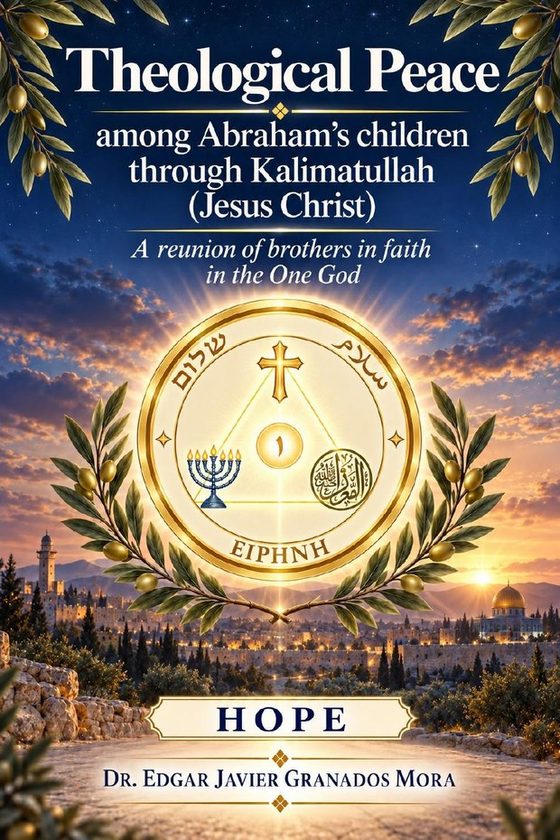
Theological Peace
Among Abraham's children through Kalimatullah (Jesus Christ)
A reunion of brothers in faith in the One God
Three religions proclaim that God is One, and they have spent centuries arguing without reading each other. This book sits them down around their own Scriptures: without hiding the differences, without caricaturing or disrespecting any faith, and without inventing a fourth religion — all the way to a philosophy of what Jesus means for God and for the three Abrahamic faiths.
Written by a Costa Rican surgeon. The finding first, the interpretation after.
Hope
A short, complete book — the way in to Theological Peace. Free, as a PDF, right now.
- Abraham Can Still Gather His Children
- What If My Sin Is Too Great for God to Love Me?
I have just written to you
Open your inbox and click the confirmation button. It takes ten seconds, and it is what lets me send you Hope without it landing in spam.
Nothing after a couple of minutes? Check your spam or junk folder. The first one usually lands there.
Done. Both are ready for you.
Take both if you like. It is the same text in two languages.
I have just written to you: open that email and confirm it. It is the one step left, and without it I will not be able to tell you the day Part II comes out. If it does not arrive within a couple of minutes, look in spam or promotions — it often lands there the first time.
7 pillars, 21 investigations
Seen from the hardest angle — the one each tradition would rather not look at — all the way to Theological Peace.
- ✦Who the Angel of YHWH is, and what the text says before we decide his identity.
- ✦Why Islamic tradition came to call Jesus Kalimatullah, the Word of God, and what exactly the Qur'an says about it.
- ✦The real disagreement between Christianity and Islam over the Cross, set out without softening it.
- ✦How the Trinity and tawhid can be understood without falling into three gods or into a simplistic negation of Christianity.
- ✦The Letters of the Suture: a personal call to reunion among Jews, Christians and Muslims.
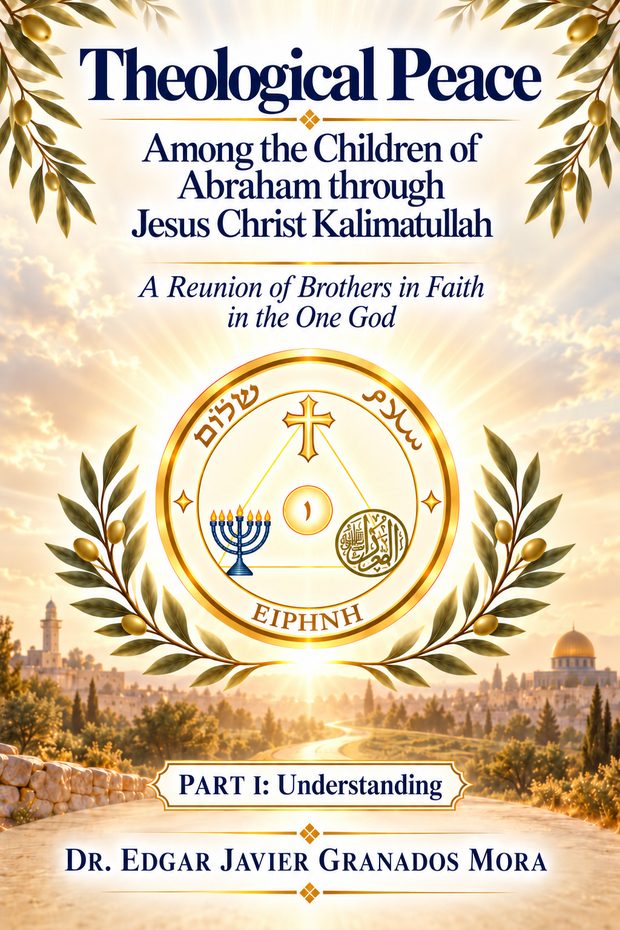
Part I: Understanding
Twenty-one investigations across Judaism, Christianity and Islam, each taken from the hardest angle for the position being examined. 196 pages.
Delivered as a PDF, instantly, to the address you pay with.
- ✦The complete book as a PDF, readable on any device, with no app and no account.
- ✦The three Letters of the Suture, the two appendices and Appendix 333.
- ✦Future corrections and expansions of Part I, without paying again.
English and Spanish, together
The same book in both tongues: Understanding and Entendimiento, each with its scripture quoted in the language that tradition reads it in. Useful if you want to pass it to someone who reads no English, or to compare how one passage sounds in two traditions.
What you will not find. A new religion, or a disguised invitation to leave your own. The author writes from his Christian faith and says so on page one. His commitment is a different one: that Jewish and Muslim readers recognize their own faith in how it is described.
How it works. Payment is handled by Gumroad, which sends you the receipt and the download link. I never see or store your card details. It is a single payment: no subscription, no renewal. If you have any trouble with the download or the file, write to me and I will sort it out. And if you would rather judge before paying, Hope is free for exactly that reason.
One word, in three tongues
If what you have read seems worth it to you, you can support it with a voluntary contribution. It buys nothing and gives access to nothing. It pays for what comes next: the translations into other languages, and the video work that carries this message where a book alone does not reach.
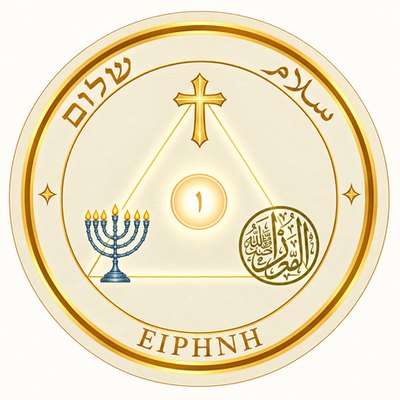
On this project's seal, the word peace is written three times: in Hebrew, in Arabic and in Greek. Three languages that have been at war, and one word that means the same in all three. Becoming a member is putting your name behind it.
The three words are worth the same. The amount is yours to choose.
- ✦The translations: the English edition of Part I, professionally edited, then Arabic, then whatever follows.
- ✦The video work: the narrated videos of each chapter — how this reaches people who do not read books.
- ✦The professional editing of Parts II and III.
- ✦Keeping Hope free for anyone who asks for it.
- ✦The 21 investigations narrated, with the Hebrew, Greek and Arabic on screen.
- ✦Part II · Liberation
- ✦Part III · Reunion
- ✦The full audiobook.
What it is and what it is not. It is a voluntary contribution, one single time. It is not a subscription, it does not renew, and you will never be charged again. It buys access to nothing: everything I publish will reach people who gave nothing exactly the same way, and Hope will stay free for everyone. If you want to support the project without paying, sharing the book with someone it would help is worth just as much.
What people ask
Does this book want me to change religion?
No. It asks you for something different and harder: to read what the other person believes in a way so fair that he could answer, «yes, that is really what I believe».
That said, the author does not hide: he writes from a Christian conviction and declares it openly in the first pages, before asking you for anything. What you do with that proposal is yours to decide.
Is this neutral interfaith dialogue?
It is not, and the book says so in plain words in a section called «Before we go on: what this book intends». It is a testimony and an argument, written from the author's Christian faith, holding that Jesus — Kalimatullah, the Word of God — is the way to the Father.
What it does do, in every chapter, is describe Judaism and Islam the way they describe themselves, even when that makes its own argument harder to sustain.
I am Jewish. Is it worth my time?
The epilogue opens by acknowledging that for most of two thousand years the damage between the two houses ran in one direction, and that it was done with the Christian Bible in hand. It asks you to investigate nothing.
It asks something smaller: to consider that a Christian can write about his faith without wanting to dissolve yours.
I am Muslim. How does the book treat the Qur'an and Muhammad?
With the sources in plain sight. The book does not claim the Qur'an secretly teaches Christianity: it acknowledges that Surah 4:171, in the very verse that calls Jesus the Word of God, rejects saying «Three» and reaffirms that God is One. Both halves stand.
Qur'anic quotations are the author's own rendering, checked against standard translations, with surah and verse given every time so you can compare them with the translation you trust.
Which Bible translation does the English edition use?
The King James Version, which is in the public domain. The Spanish edition uses the Reina-Valera 1960.
When does the English edition come out?
There is no date yet, and I would rather say that than invent one. The Spanish edition is already published; the English one is being prepared with a professional editor, because a book that asks for this much care in reading deserves the same care in translation.
Leave your email and you will know the day it opens.
If I contribute, will I be charged again?
No. The contribution happens once. It is not a subscription, there is no renewal, and no scheduled charge is left in your name.
Nor does it buy access to anything: whatever I publish will reach people who gave nothing just the same, and Hope will stay free for everyone.
Who wrote this?
Dr. Edgar Javier Granados Mora, a Costa Rican general surgeon. The book was born in the small hours of Holy Saturday 2026, during a hospital shift, while he waited for his son's MRI.
The research leaned on artificial intelligence tools to trace and compare passages across the three texts — something the book itself declares openly in its first pages.